
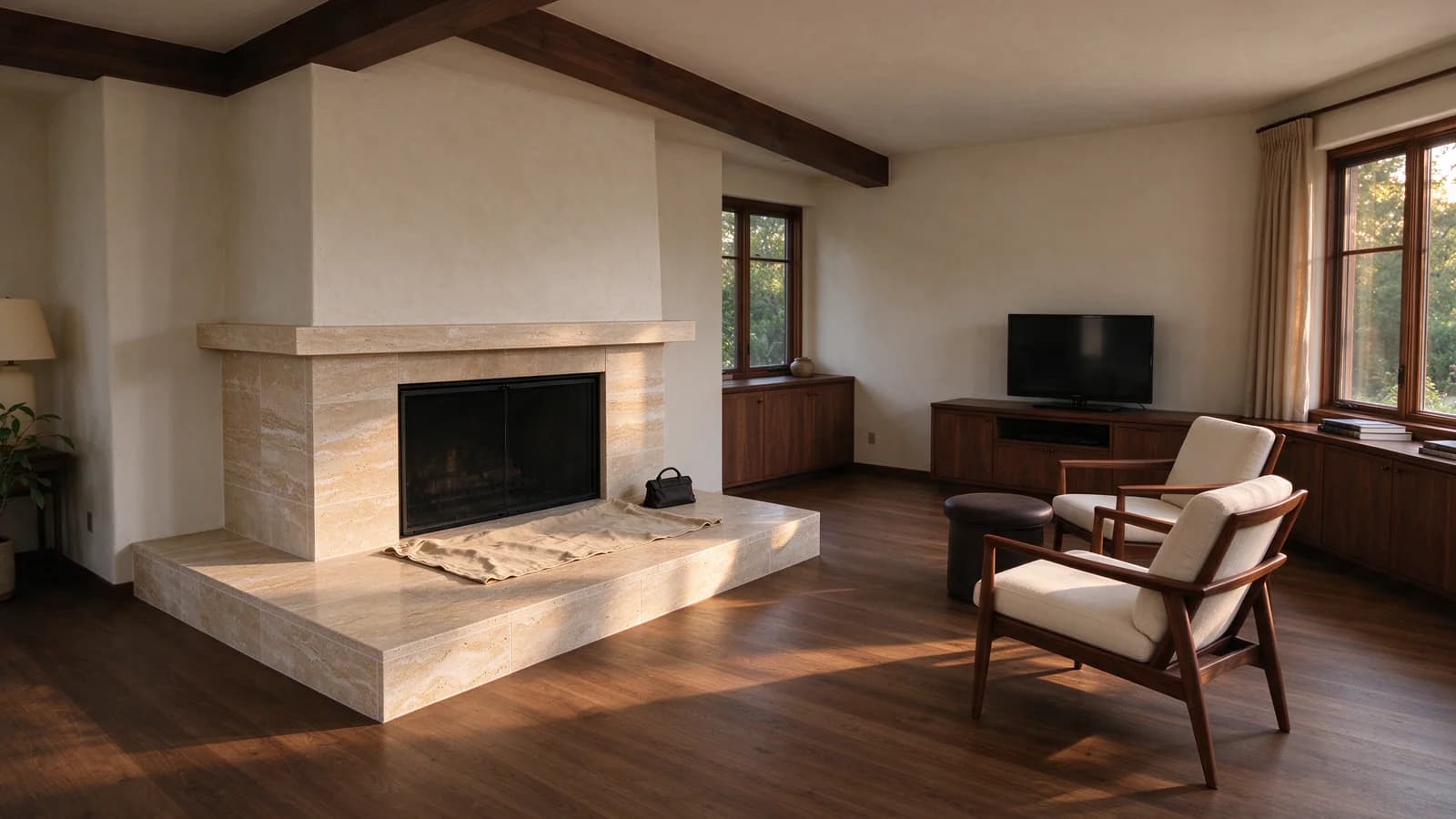
A good gas fireplace inspection covers five checks: a full inspection of the unit, a gas leak check, wiring and controls, a safety check and a maintenance check. Our $99 gas fireplace safety inspection covers all five for every gas fireplace in your home. Below, we explain each check and what the manuals ask of owners.
The five checks at a glance
An inspection answers one question: is this fireplace in safe working order, and if not, what needs attention? Our checklist breaks that question into five parts. They appear below in the same order as on the checklist, and each one gets its own section further down.
- Full inspection: a look over the whole fireplace and its recent history.
- Gas leak check: making sure gas stays inside the valve, pipe and fittings that feed the fireplace.
- Wiring and controls: the wall switch, remote, receiver, batteries or power supply, and the wiring that links them.
- Safety check: the parts that keep the fireplace safe to use, such as the glass front and the device that stops the gas if the flame goes out.
- Maintenance check: what upkeep the fireplace is due for. Cleaning is extra; the $99 covers the inspection only.
1. Full inspection: the whole fireplace first
A full inspection starts with the big picture. The technician looks over the firebox, the glass front, the logs or other media, the burner area and the controls, and asks how the fireplace has behaved since it last worked well.
Your notes make this part faster. Before the visit, write down when the fireplace last ran normally, any smell, sound or change in the flame you noticed, and anything done to it since then, such as work nearby or a summer shutdown. Find the model and serial number too. Each manual shows where that label sits; the Valor Portrait manual, for example, puts it on a plate under the firebox, reached through the bottom panel.
Ask questions as the technician works. A good inspection ends with a plain account of what was looked at, what was found and what, if anything, needs to happen next. You should be able to repeat it to anyone else in the house.
2. Gas leak check
The gas leak check makes sure gas stays where it belongs: inside the valve, pipe and fittings that feed the fireplace. It is the check that matters most, and the one homeowners should never try themselves.
Manufacturers treat it as yearly technician work. The Valor Portrait and Kozy Heat Springfield 36 manuals both put a leak check of the gas tubes, pipes and connections that can be reached on their list of annual tasks for a qualified technician.
If you smell gas at any point, don't wait for an appointment. Leave the home first, then call your gas company's emergency line or 911 from outside. Our page on what to do about a gas smell or CO alarm has the full steps.
3. Wiring and controls
If your fireplace lights from a wall switch or a remote, there is a chain of parts between your button and the flame: a receiver, a control module or valve, batteries or a power supply, and the wiring that links them. The wiring and controls check covers that whole chain.
In the manuals, this shows up as a yearly check for faulty or incorrect wiring. The Valor manual adds a caution to label every wire before a control is disconnected, because wiring mistakes can make a fireplace run improperly and dangerously. That is technician work. Your part is simpler: note whether the remote, the wall switch or both have been acting up, and since when.
Controls that work one day and not the next point to this part of the system. Our page on a gas fireplace remote that isn't working lists the causes, and remote and control repair explains what fixing them involves.
4. Safety check
The safety check looks at the parts that exist to protect you. On a glass-front gas fireplace, two matter most: the glass front and the flame safety system.
The glass front has to be in place and sealed before the fireplace runs. The Valor manual says never to operate it with the glass removed, cracked or broken, and warns that a window that isn't installed correctly can leak carbon monoxide. It also says to put the barrier screen back on the front after any maintenance.
The flame safety system shuts off the gas if the pilot or flame goes out. The Valor and Kozy Heat manuals both ask a qualified technician to inspect it every year and to time how fast it reacts: it has to shut the gas off within 30 seconds.
When this part of the system acts up, one sign is a pilot that lights and then goes out. If that sounds familiar, read about a pilot light that won't stay lit.
5. Maintenance check
The maintenance check tells you what upkeep the fireplace is due for: cleaning, parts that are wearing, and anything the manual schedules that hasn't been done. You get the list; you decide what to do about it.
Cleaning isn't part of the $99. The inspection finds out what the fireplace needs, and cleaning is extra if you want it done.
The manuals explain why cleaning comes up so often. Both the Kozy Heat and Valor manuals say the control compartment, burners and air passages must be kept clean, and that rooms with a lot of lint from carpets or bedding may need cleaning more often than once a year. For ongoing care, see gas fireplace maintenance.
Inspection, maintenance and repair: three different jobs
Inspection, maintenance and repair get used as if they meant the same thing. They don't, and knowing which one you need makes booking easier.
They do connect. An inspection often leads to maintenance or a repair, which is why the $99 is credited toward any repair we do. If you already know something is broken, start with gas fireplace repair.
- Inspection: what condition is the fireplace in? It is the five checks above. It finds problems; it doesn't fix them.
- Maintenance: what upkeep does the manual call for? Cleaning and routine care, booked as their own job.
- Repair: what is broken, and what will it take to fix it? Parts and labor for a specific fault.
What you can check safely before the visit
None of these steps involves opening the fireplace or touching gas or electrical parts. They are the owner-level checks the manuals allow, and they help the technician start in the right place.
- Make sure the wall switch is on and that the fireplace has power, if your model uses it.
- Check the batteries in the remote, and in the receiver's battery holder if your model has one. The Valor manual says to turn the fireplace off, pilot included, and let it cool before changing them.
- See whether the gas shutoff valve for the fireplace is open. If it is closed and you don't know why, leave it closed and mention it when you book.
- Confirm the glass front is in place and not cracked. Don't touch it if the fireplace has been on; the glass stays hot after the flame goes out.
- Find the lighting instructions and the model and serial number label, and keep the manual handy if you have it.
- Clear the hearth and the floor in front of the fireplace, and keep anything that can burn away from it.
When to stop and call
Some signs mean the fireplace should stay off until a technician sees it. Don't wait for a routine inspection if you notice any of these.
- You smell gas. Leave the home first, then call the gas company's emergency line or 911 from outside.
- A carbon monoxide alarm sounds. Get everyone outside, then follow the same steps.
- The glass is cracked, broken or missing. The manuals say not to run the fireplace that way.
- Any part of the fireplace has been under water. Both manuals say to call a qualified technician to inspect it before it is used again.
- The flames look dark or dirty, or soot keeps building up on the glass or logs. The Valor manual treats building soot as a sign the burner needs adjusting or the logs are out of place.
- It won't light after you've checked the switch and batteries, or it lights and then goes out.
Questions to ask before the technician leaves
An inspection is only as useful as what you take away from it. These questions turn the five checks into decisions you can act on.
- What did you check, and what did you find on each of the five?
- Is the fireplace safe to use as it is today?
- What needs fixing now, and what can wait until the next service?
- Does my manual call for anything that wasn't part of today's visit, such as cleaning?
- When should it be inspected again?
Who can inspect a gas fireplace in Massachusetts
In Massachusetts, gas fitting is a licensed trade. The state's Board of State Examiners of Plumbers and Gas Fitters examines and licenses gas fitters, and its consumer fact sheet tells homeowners to hire a licensed professional and to verify the license with the board. Every inspection we do is carried out by a licensed Massachusetts gas fitter.
Timing matters here, too. A Greater Boston gas fireplace usually sits unused through the warm months, and the first cold evening of fall is often when a problem shows up. An inspection in late summer or early fall leaves time for any repair before you rely on the fireplace. If yours won't start or smells odd after the break, see our guide to starting a gas fireplace after summer. For how often to repeat the inspection, read how often a gas fireplace should be serviced.
We work in 68 towns across Greater Boston, with same- or next-day visits. Some, like Newton, have their own page with local permit and gas company details.
Booking the $99 inspection
The $99 gas fireplace safety inspection covers the five checks above, and one price covers every gas fireplace in your home. It is an inspection only; cleaning is extra. If it turns up something to fix, the $99 is credited toward any repair. It is a limited-time offer.
To book, request a visit online or call 617-915-2647. An online booking is a request, and our team confirms it by phone or email. Visits run Sunday through Friday from 8am to 6pm, in 2-hour arrival windows: 8–10, 10–12, 12–2, 2–4 and 4–6.
Before you book, read what the $99 inspection includes, and have your notes and the model number ready for the visit.
Sources & further reading
Valor Portrait 530V homeowner's manual: annual service, safety and FAQ sections ↗Kozy Heat Springfield 36 installation and operation manual: maintenance section ↗Mass.gov: Plumbers and gas fitters consumer fact sheet ↗Always follow the instructions for your exact fireplace model.

