A gas fireplace that won't turn on, won't stay lit or keeps shutting off needs a diagnosis, not guesswork. A licensed Massachusetts gas fitter finds the cause and repairs it, with same- or next-day visits Sunday through Friday, 8am to 6pm, across 68 Greater Boston towns. Start with our $99 gas fireplace safety inspection: it covers every gas fireplace in your home, and if a repair is needed, the $99 is credited toward it.
Signs your gas fireplace needs repair
Book a repair visit if your fireplace does any of these. Each linked page explains the likely causes and the checks you can safely make first.
- It won't turn on from the wall switch or the remote.
- The pilot light won't stay lit, or won't light at all.
- The pilot is lit but the burner won't come on.
- The fire keeps turning off a few minutes after it starts.
- The remote has stopped working, even with fresh batteries.
- The burner lights late, with a whoosh, or only partly.
- Soot is building up on the logs or firebox walls, or the flames look dark and dirty.
- Any part of the fireplace has been under water. Manuals say not to use it until a qualified technician has inspected it and replaced any control or gas-control part that got wet.
What we check and fix
Repair starts with finding the cause, because one symptom can come from several places. A fireplace that won't light might have dead batteries, a failed pilot part, a faulty control or a closed supply valve.
The gas fitter starts with how the fireplace behaves: what happens when you press the switch, whether the pilot lights, and whether the burner follows. From there the check runs in the order the fireplace itself works: power and controls, then the pilot, then flame sensing, then the gas valve and burner. The fitter then repairs the part that failed.
When a part needs replacing, it has to match what the manufacturer lists for your model. A part that looks the same isn't proof it fits.
The repairs we handle fall into a few groups:
- Pilot and ignition: pilots that won't light or stay lit, igniters that click without lighting, and the thermocouples, thermopiles and flame sensors that tell the gas valve a flame is present. See pilot light and ignition repair.
- Gas controls: control valves that won't open to the pilot or burner, or won't respond to the switch, remote or thermostat. Valve diagnosis is part of ignition repair.
- Remotes, receivers and switches: handsets that lost their pairing, receivers that lost power, and wall switches or thermostats that no longer reach the fireplace. See remote and control repair.
- Burner problems: slow or uneven lighting, weak flames, and dark, sooty flames that point to a burner needing attention.
- Shutdowns: fires that go out partway through, which can trace back to the pilot, the controls or the fireplace's own safety features.
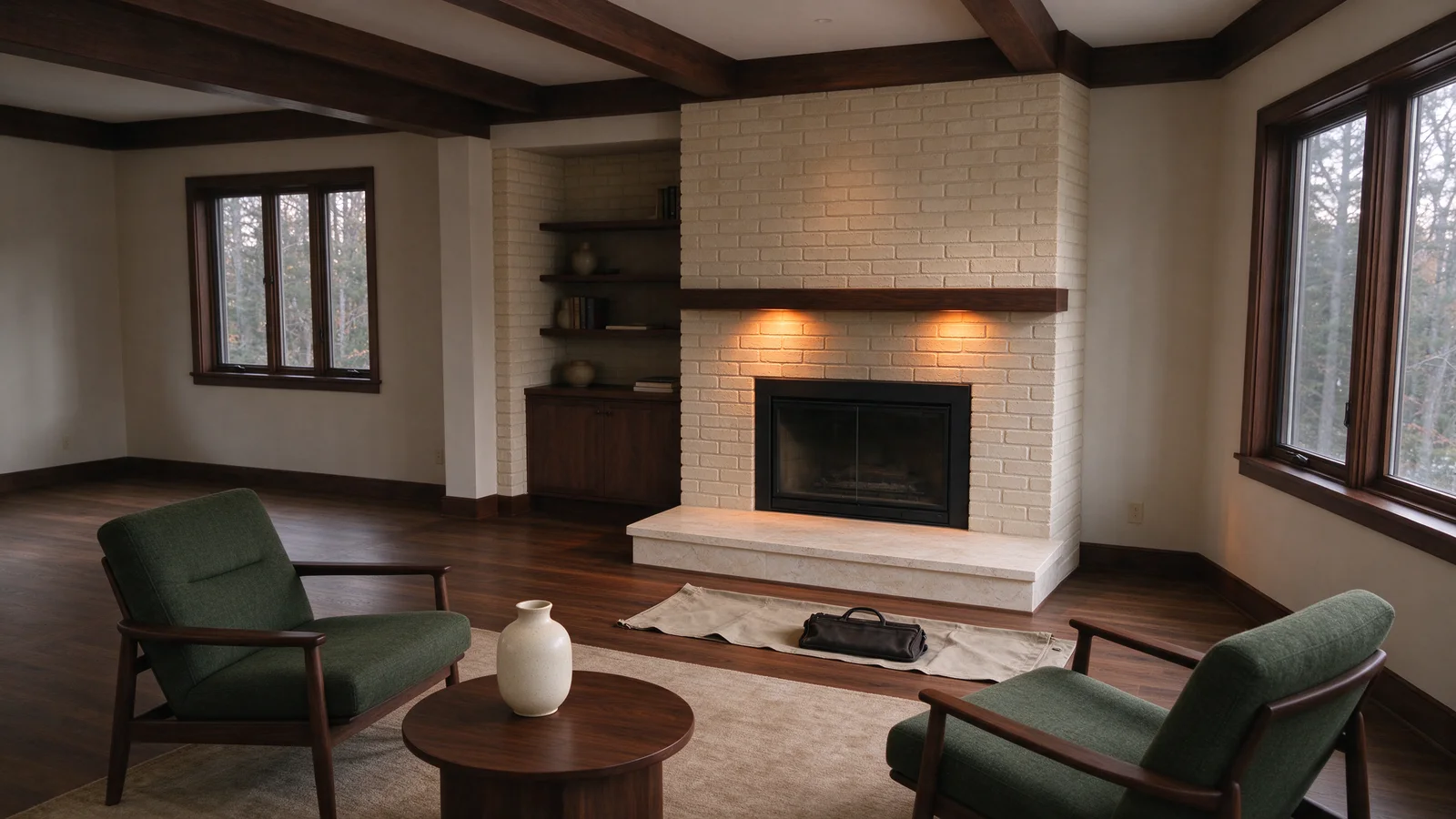
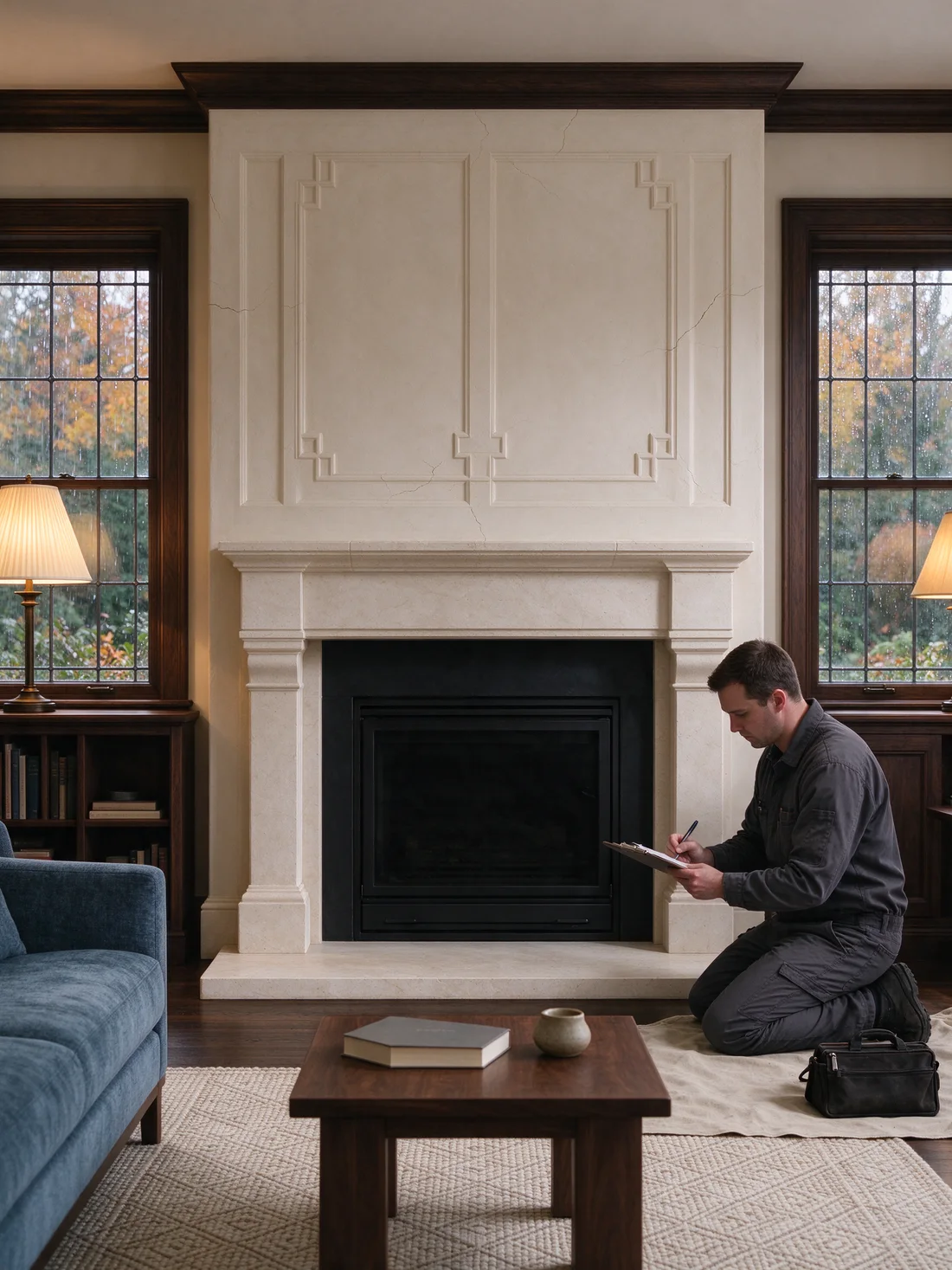
Design concept: a representative illustration. It does not document a customer project or certify appliance suitability.
How a repair visit works
Book the visit online or call 617-915-2647. Booking online sends a request, and we confirm your time by phone or email.
Choose a 2-hour arrival window between 8am and 6pm, Sunday through Friday: 8–10, 10–12, 12–2, 2–4 or 4–6. Same- or next-day visits are available.
The visit starts with the $99 inspection: a full inspection, a gas leak check, wiring and controls, a safety check and a maintenance check, for every gas fireplace in the home.
The gas fitter explains what failed and quotes the repair. Your $99 is credited toward it, so the inspection isn't a separate cost on top of the repair.
It helps to know your fireplace's model and serial number. They're on a label or card attached to the fireplace, often near the controls. One manual places the card at the bottom of the fireplace, under the firebox, and warns not to reach for it while the fireplace is hot.
What you can check safely first
A few owner-level checks can save a visit. They're the same ones fireplace manuals allow owners to make. Leave everything else, including the gas valve, burner, pilot assembly, wiring, venting and gas connections, to the gas fitter.
If you smell gas at any point, stop. Leave the house, then call 911 or your gas company's emergency line from outside. Our page on a gas smell or CO alarm has the full steps.
- Make sure the wall switch is on and the fireplace has power.
- Put fresh batteries in the remote, and in the receiver if your manual shows owners how. One manual's troubleshooting section suggests this first when a fireplace won't turn on.
- Check whether the gas supply valve to the fireplace is open. If it's closed and you don't know why, leave it closed and call us.
- Make sure the glass front is in place and not cracked. Manuals say not to run the fireplace with the glass removed, cracked or broken.
- Read the lighting instructions on the plate or card near the controls. On a standing-pilot fireplace, follow only those printed steps to relight it.
Normal behavior that isn't a fault
Not everything unusual needs a repair. Fireplace manuals describe these as normal, so they're worth knowing before you book:
- Popping or snapping as metal parts heat up and cool down, and a whir from the valve motor when the flame height changes.
- A slight odor for a few hours on the first fire after a summer off, as dust burns off. A gas smell is a different matter and calls for the safety steps above, not a repair booking.
- Condensation on the inside of the glass right after the fireplace turns on, which clears as it heats up.
- Flames that start out blue and turn more yellow and orange as the fireplace warms.
- On models built to do it, a pilot that turns itself off after several days without use, or a fire that drops to pilot after hours with no signal from the remote.
Why a licensed gas fitter
In Massachusetts, gas fireplace repair is gas fitting. State law defines gas fitting to include connecting and testing gas appliances, keeping gas systems in good and safe condition, and making necessary repairs.
The Board of State Examiners of Plumbers and Gas Fitters, which examines and licenses gas fitters, says repairing gas equipment, venting included, is work for a licensed plumber or gas fitter or a trained person they supervise. Permits for gas fitting work are issued only to licensed plumbers and gas fitters.
Manufacturers agree. Fireplace manuals include a Massachusetts note that the gas piping and final connection must be done by a licensed plumber or gas fitter, and they leave repair to a qualified service person. In Boston, the city's gas permit for installing or replacing gas appliances is open only to licensed contractors, and homeowners must hire one for both the permit and the work.
Where we repair gas fireplaces
We repair gas fireplaces in 68 towns across Greater Boston, from the North Shore to the South Shore. See our local pages for Boston, Cambridge, Newton, Quincy and Melrose, or check every town we serve.
Ready to get your fireplace working again? Book your $99 inspection or call 617-915-2647. If it needs a repair, the $99 is credited toward it.
Sources & further reading
Massachusetts Board of State Examiners of Plumbers and Gas Fitters: Venting of Flue Gases policy ↗Mass.gov: Plumbers and gas fitters consumer fact sheet ↗City of Boston: Gas Permit ↗Mass.gov: What to do if you smell gas ↗Valor H4 direct vent gas fireplace homeowner's manual (PDF) ↗Valor Legend G3 gas insert installation and owner's manual (PDF) ↗Always follow the instructions for your exact fireplace model.